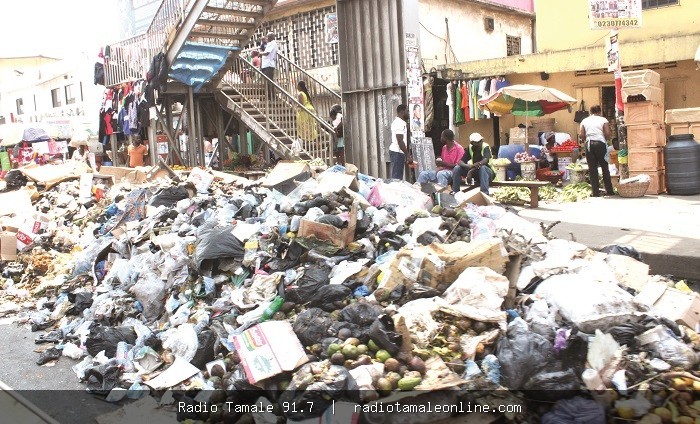
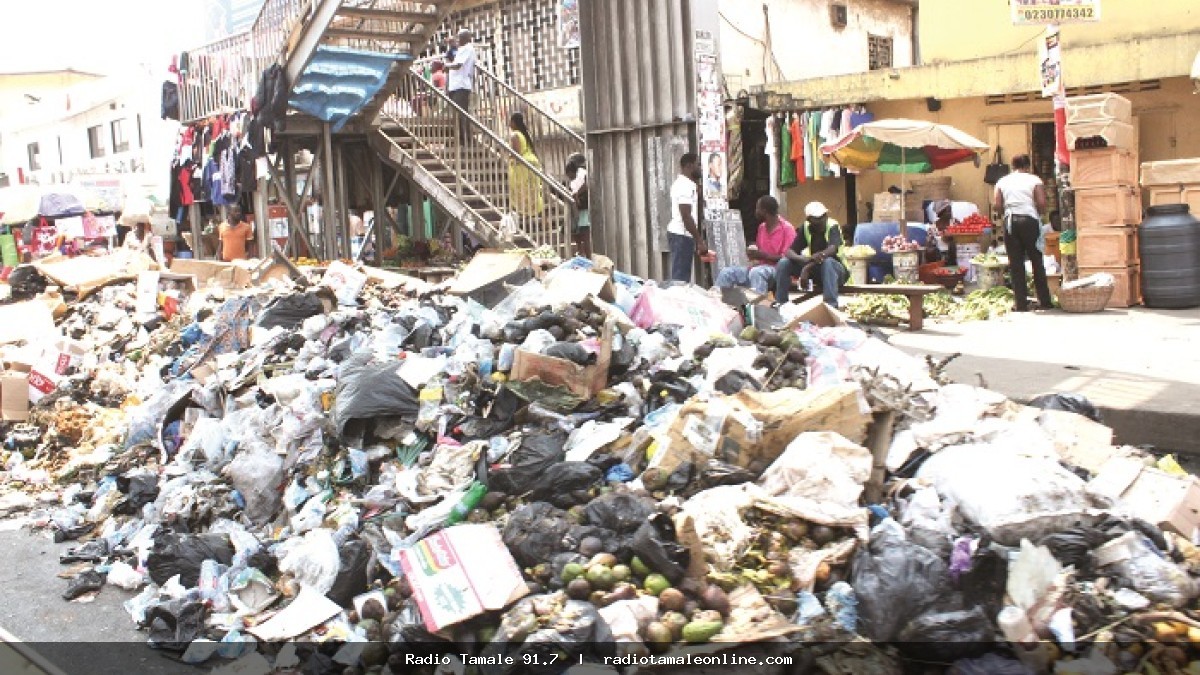
Researchers say government must urgently scale up sanitation investment as preventable diseases cost 31.9 million work and school days. Ghana is losing more than GH¢6.2 billion every year through healthcare costs and lost productivity associated with poor waste management and sanitation, according to a new policy brief by the Institute of Statistical, Social and Economic Research (ISSER) of the University of Ghana.
The figure dwarfs the amount currently being spent by Metropolitan, Municipal and District Assemblies (MMDAs) to manage waste and sanitation.
According to ISSER’s February 2026 policy brief, all MMDAs collectively spent approximately GH¢180.2 million on waste management and sanitation, compared with more than GH¢6.2 billion in annual health and productivity losses arising from inadequate waste management.
The researchers describe the situation as an unsustainable imbalance in which Ghana is spending substantially more to deal with the consequences of poor sanitation than to prevent them. The study estimates that the country suffers approximately GH¢5.58 billion in direct medical expenses and a further GH¢650 million in lost productivity every year because of poor waste management.
The resulting burden includes preventable diseases such as malaria, cholera, and typhoid.
ISSER estimates that these sanitation-related illnesses account for 31.9 million lost work and school days annually, while contributing to an estimated 107,222 premature deaths every year.
‘The economics of inaction’
The findings fundamentally challenge the perception that sanitation is simply a social or environmental obligation. ISSER argues that waste and sanitation should instead be treated as a strategic economic investment, because the cost of failing to invest is substantially greater than the resources required to address the problem.
The researchers say rapid urbanization, population growth and changing consumption patterns are generating unprecedented volumes of solid and liquid waste, overwhelming the capacity of many MMDAs.
The consequences, they warn, extend beyond dirty streets and overflowing waste sites to public health, productivity and economic development. The report therefore calls for an urgent shift in government policy.
Government must increase investment
ISSER recommends a significant increase in public investment in sanitation, drainage and environmental health. The researchers specifically recommend prioritizing interventions with the highest health returns, including safe faecal sludge management and the elimination of open refuse dumps that contribute to the spread of disease.
They also want the government to direct capital investment towards high-risk urban and peri-urban communities, particularly densely populated slums, flood-prone neighborhoods and underserved areas.
According to ISSER, these targeted interventions could reduce disease incidence and mortality while addressing the disproportionate sanitation burden carried by vulnerable communities.
The financing gap
The scale of the financing gap is perhaps the most disturbing aspect of the report. The study estimates current average investment in waste management at only GH¢38.78 per tonne of waste.
ISSER compares this with GH¢1,028 per tonne, which it uses as an average investment benchmark for lower-middle-income countries in its best-case scenario. The researchers argue that Ghana cannot continue to treat sanitation expenditure as a discretionary cost.
Instead, sanitation should be incorporated into national economic planning as an investment capable of generating substantial returns.
The report specifically recommends that the health and economic benefits of improved sanitation be incorporated into government budgeting and medium-term expenditure frameworks.
An urgent call for action
The ISSER findings present government with a compelling economic argument for urgent action. The country is effectively paying billions of cedis every year for failing to adequately invest in sanitation.
Government therefore faces a choice: continue spending relatively little on prevention while absorbing enormous costs from disease, healthcare, and lost productivity, or significantly increase investment in the infrastructure and systems needed to prevent those losses.
ISSER’s recommendation is unequivocal: Ghana must scale up investment in sanitation and drainage systems, prioritize high-risk communities and bring waste-management investment closer to international standards.
For government, the message is increasingly difficult to ignore: Sanitation is not an expense Ghana can afford to postpone. It is an economic investment that the country may no longer be able to afford to neglect.








0 Comments